


CBT Therapy in Epsom, Surrey
Evidence-based therapy for anxiety, panic attacks, OCD, social anxiety, and low self-esteem
Many of my clients come to CBT after years of trying to manage anxiety on their own - reading books, using apps, telling themselves to "just stop worrying." CBT is different. It gives you practical tools to interrupt the cycles that keep anxiety going.
If you are struggling with anxiety, panic attacks, OCD, social anxiety, or patterns of thinking that keep you stuck, CBT (Cognitive Behavioural Therapy) can help.
I am Thulasi, a BABCP Accredited CBT Therapist based in Epsom. I specialise in helping people break free from anxiety and build lives that feel manageable again.
CBT is recognised by the NHS and NICE as the gold standard treatment for anxiety disorders. It works by helping you identify and change the unhelpful patterns of thinking and behaviour that maintain your distress.
You Don't Have To Keep Living Like This
CBT may be right for you if any of the following feels familiar:
You worry constantly - even about things you know logically don't make sense to worry about
Panic attacks come out of nowhere, and the fear of having another one is limiting your life
You avoid certain situations, places, or people because the anxiety feels unbearable
You have intrusive thoughts or compulsions (OCD) that you can't seem to control
Social situations fill you with dread - you worry about being judged, saying the wrong thing, or looking anxious
You replay conversations over and over, convinced you've embarrassed yourself or upset someone
You set impossibly high standards for yourself, and anything less than perfect feels like failure
Your self-esteem is so low that you struggle to believe you're good enough at anything
You know your anxiety is out of proportion to the situation - but that knowledge doesn't make it stop
You've tried self-help strategies and they work for a while, but the anxiety always comes back
CBT doesn't just teach you to "cope" with anxiety. It helps you understand what drives it - and gives you the tools to change it.
Understanding the Anxiety Cycle
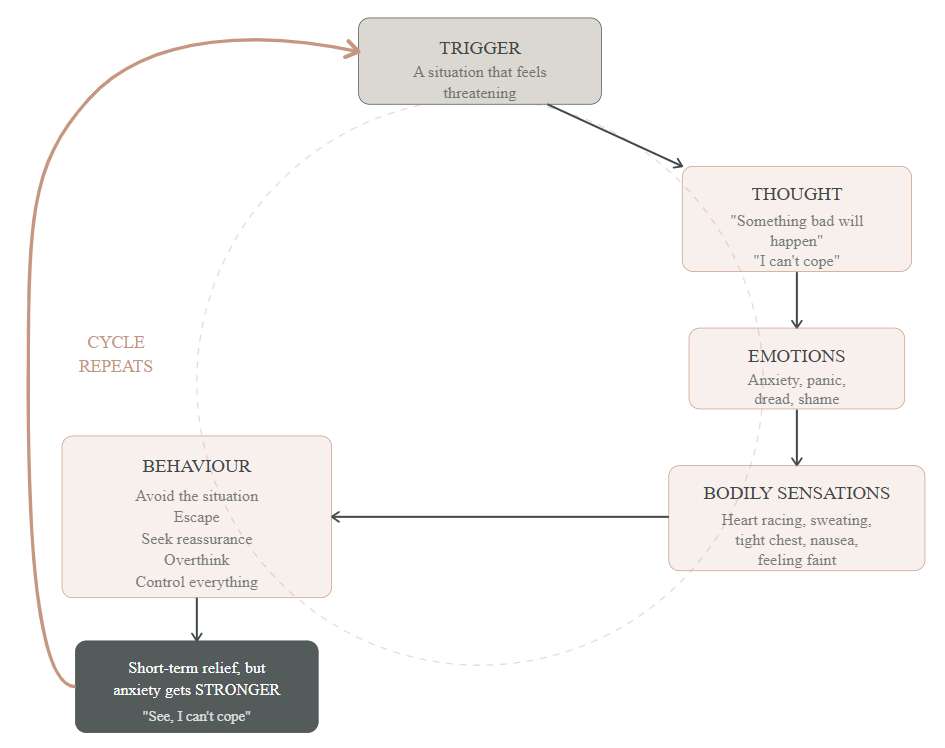
Anxiety doesn't exist in isolation. It's maintained by a cycle - patterns of thinking, feeling, and behaving that reinforce each other. Here's how it works:
When you avoid something because of anxiety, you get short-term relief - but your brain learns "that situation IS dangerous, avoidance kept me safe." The anxiety gets stronger. This is why self-help strategies often don't last - they target symptoms, not the cycle maintaining them.
How CBT Breaks the Cycle
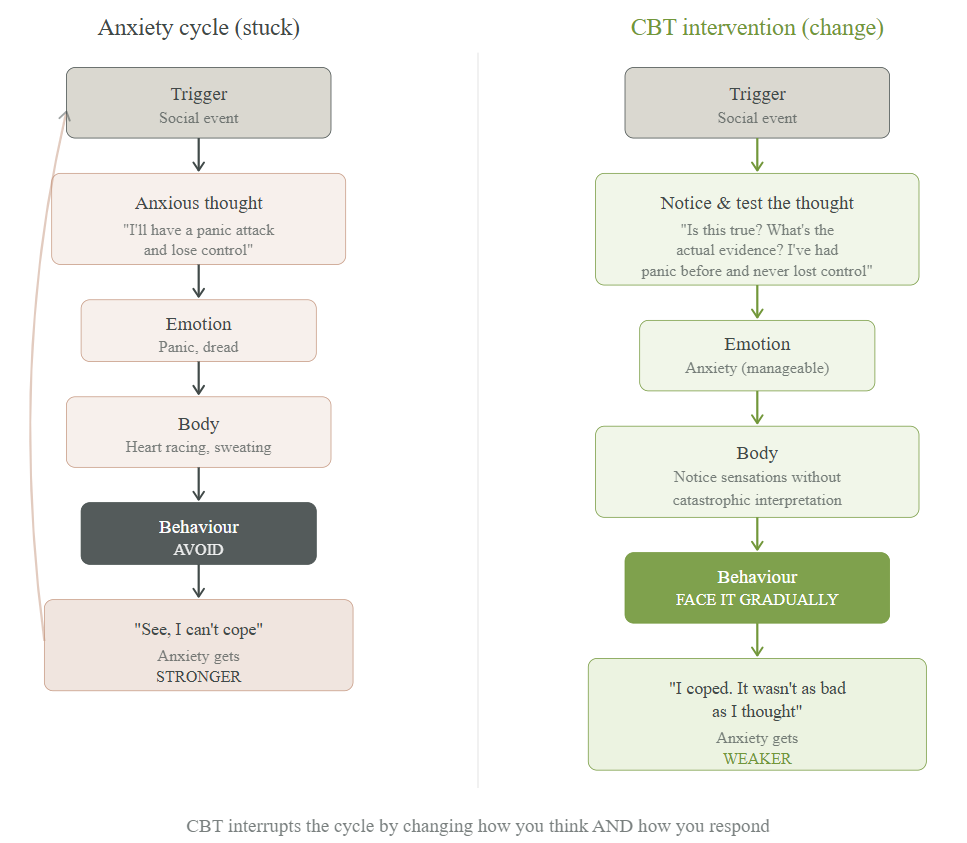
CBT works by interrupting the anxiety cycle at multiple points. We look at your thoughts, emotions, bodily sensations, and behaviours - and change what's keeping the pattern stuck.
CBT isn't about positive thinking or "just relaxing." It's about testing your anxious predictions in reality, changing your responses, and letting your brain learn through experience that what you've been avoiding isn't as dangerous as anxiety has made you believe.

I've been in private practice since 2017, and over the years I've noticed a pattern. People come to me having tried therapy before, sometimes multiple approaches, and while they've gained insight and understanding, they're still circling around the same issues. Something hasn't quite shifted.
Here's what I've learned: insight alone doesn't create change. Real change happens when you work with both mindset and behaviour simultaneously. It’s about understanding how you make sense of the world, yourself, and others, and then actively interrupting the patterns that keep you stuck.
I'm a BABCP Accredited CBT Therapist with 16,000+ clinical hours across 20 years in the NHS and nearly 10 years in private practice. I adapt the therapeutic approach to how you think, how you learn, and what's actually keeping you stuck.
For some clients, CBT alone is enough. For others, especially those experiencing what I call the "heart-head lag," where your head knows something logically but your heart feels something different, that's when I bring in EMDR. Because sometimes there's something a layer deeper that needs addressing, and EMDR gets there faster.
What keeps me doing this work after all these years is the relationships. I get to know my clients so deeply. I have the privilege of witnessing people do extraordinarily brave things. They face their fears, sit with feelings they've spent years avoiding, and discover strengths and capacities they didn't know they had. They trust me to ask difficult things of them. That's humbling. And honestly? They inspire me.
I see myself as ordinary. But through my partnership with my clients I have learned that ordinary people can do extraordinary things when they're given the right support. And that's what I'm here for.
What My Clients Say
-
"I feel liberated of those fears! Having learned some great tactics with your support, I'm now able to calm myself in situations and also feel confident doing things I never thought I could do anymore. This has given me a new outlook on life and the ability to clear my mind of the noise."
— Head of People Partners | Commercial Real Estate
-
"The whole process has been truly educational, strengthening and enlightening. Our sessions developed from dealing with social anxiety and low self-esteem to making positive changes within my life. I would highly recommend Thulasi."
— CBT Client
-
"Thulasi is the therapist I never knew I needed. She's been great at guiding me to realise and name parts of myself, which I found immensely helpful in coping with my worry - the stem of much of my anxiety. I love that she provides her opinion with permission when needed, as her voice provides a different perspective that I find insightful."
— Client Solutions Manager | Marketing

Frequently Asked Questions
-
This depends on the nature and severity of your issue. For specific issues you might notice significant improvement within 8-12 sessions. For more longstanding difficulties that may be rooted in past experiences - we may work together for 4-6 months or longer. We'll review progress regularly to ensure the approach is working for you. My aim is always to help my clients feel better as quickly as possible to move forward in your lives.
-
Counselling tends to be exploratory and reflective. It focuses on understanding your feelings and experiences. CBT is more structured and practical. It focuses on changing the patterns that maintain your distress and unblocking the root issues. Both are valuable, but CBT is specifically designed for anxiety, OCD, panic, and low self-esteem, with a strong evidence base showing it works. My approach of CBT with my clients is a collaborative process. This means I do not expect you to sit in silence, I will share my thoughts and ideas with you and we are clear on what it is you want to change (your goals) and we make a plan of how we are going to do that together.
-
Sometimes previous CBT wasn't the right fit. Perhaps it was too brief (especially for my clients who received this on the NHS), too generic (if you have not seen a specialist), or delivered at a time when you weren't ready. I tailor CBT to your specific presentation and integrate EMDR when past experiences are contributing to current anxiety. It's worth trying again with a therapist who specialises in anxiety and trauma and is accredited in CBT.
-
This is one of the most common things I hear. And it's exactly where CBT is most effective. Understanding why you're anxious is important, but it doesn't create change on its own. CBT works with both your mindset and your behaviour simultaneously, addressing what I call the "heart-head lag". This is where your head knows something logically but your heart feels something different. When insight alone hasn't shifted things, that's when CBT (and sometimes EMDR) can help you move forward as they are what I call “change-oriented therapies”.
-
Yes. CBT - specifically a version called Exposure and Response Prevention (ERP) - is the gold standard treatment for OCD and recommended by research and the NHS. We work on reducing compulsions and challenging the beliefs that drive them, helping you regain control over the intrusive thoughts and rituals that have been dominating your life. CBT is also highly effective for panic attacks, social anxiety, health anxiety, excessive worry and general anxiety.
-
Yes. Research shows that online CBT is just as effective as face-to-face CBT. Some clients prefer the comfort of their own environment; others prefer the separation of coming to my practice. I'm happy to work in whichever way suits you best and happy to talk through the options with you so you can make an informed decision.
Getting Started is Simpler Than You Think
Taking the first step towards CBT can feel daunting. Here's what happens when you reach out:
Get in touch
1
Send me a short message via the contact form or email. There's no right or wrong way to do this — just tell me a little about what's brought you here.
We have a free 15-minute call
2
I'll be in touch personally, usually within 24 hours, to arrange a brief introductory call. This is a chance for us to speak, for me to understand what you're looking for, and for you to get a sense of whether I feel like the right fit. No commitment, no pressure.
We begin
3
If we both feel it's right, we'll agree a regular weekly time to meet. Either in person at my practice in Epsom, or online.
Book Your Free15-Minute CBT Consultation.
I offer CBT therapy in-person in Epsom and online across the UK. Use this form to get in touch.
Session fees are £135 per session. I do work with some medical insurance companies on a ‘pay and reclaim’ basis.