When Your Anxiety Seems to Follow Your Cycle
What it looks like in practice
You’ve been working on your anxiety for months and it’s loosening. Then the week before your period it’s back, with a flat mood and no energy, and you wonder if the work has stopped working.
It hasn’t.
This is one of the things I hear most, usually several months into therapy. Nobody arrives saying “I think it’s my hormones.” They come for panic, or constant worry, and somewhere along the way they notice something else.
One woman I work with came to me for her general anxiety and panic attacks. Over the months she began to notice that when her period came round, her mood dipped, she felt less motivated and more fatigued. We kept working on the anxiety, and we talked about the hormonal side too. That conversation turned out to matter as much as anything else.
Why hormones can turn the volume up
There’s a reason it can feel so sharp. Research suggests women report more anxiety and depression around the premenstrual, postpartum and peri- and post-menopausal periods, when estrogen is relatively low. It’s an area still being understood, so I wouldn’t say hormones explain everything. But they can turn the volume up on what’s already there, particularly in perimenopause when levels swing less predictably.
That doesn’t mean the anxiety is “just hormonal”, or that it’s all in your history. Usually it’s both, and they call for different responses. Try asking yourself:
“Is this about what’s happening in front of me, or is my body just in a harder week?”
What helps
A few things worth doing:
Track it alongside your cycle. A few weeks of jotting down mood, energy and sleep next to where you are in your cycle can turn a confusing dip into a pattern you can plan around.
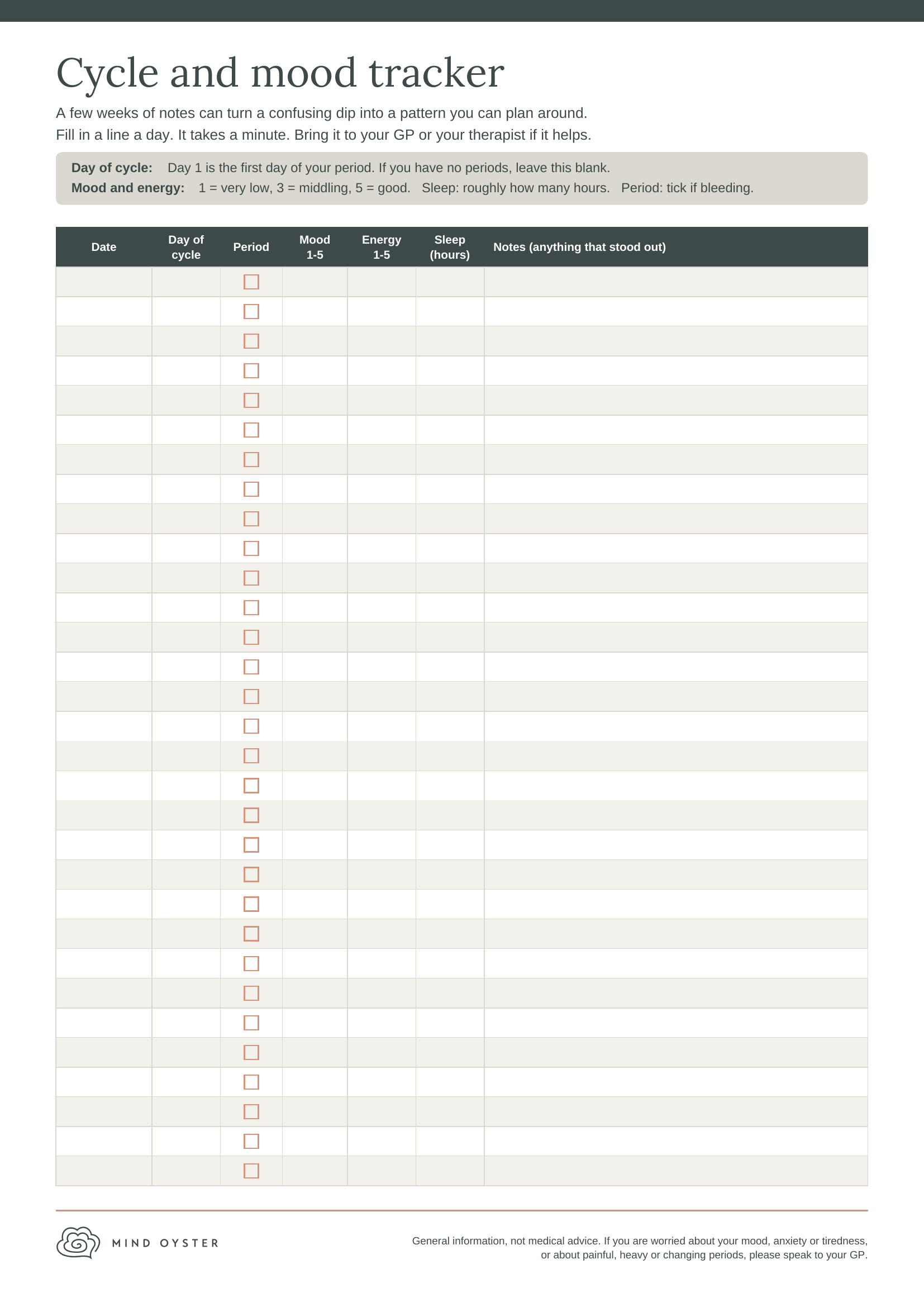
Printable cycle and mood tracker with columns for mood, energy, sleep and notes.
Go easier in the low weeks. If you know the week before your period is harder, you can protect it a little rather than judging yourself for struggling.
Tell your GP if it’s heavy or relentless. Persistent tiredness and low mood can have other causes, and medical support and therapy aren’t either/or. Many of the women I work with have a GP involved, and sometimes a psychiatrist too, as well as other support and resources to help holistically.
Where therapy fits
What therapy does here is work on the anxiety underneath. CBT helps you see how thoughts, body and behaviour feed each other. EMDR helps the brain finish processing experiences that still feel as raw as when they happened. Neither changes your hormones. But there’s less for them to amplify when the anxiety has been properly worked on.
I’m on HRT myself, and it hasn’t made all of this disappear. I don’t think there’s one thing that does. For me it’s a mixture: medication, therapy, regular exercise, eating well, and meditation, which keeps me grounded and more present.
If any of this sounds familiar, I offer a free 15-minute call and I’m happy to talk it through.
Thulasi is a BABCP Accredited CBT Therapist and EMDR UK Accredited Practitioner based in Epsom, Surrey. She offers therapy in-person and online.
This article is general information, not medical advice. If you’re worried about your mood, anxiety or tiredness, or about painful, heavy or changing periods, or you think perimenopause or menopause might be playing a part, please speak to your GP.